Address
304 North Cardinal
St. Dorchester Center, MA 02124
Work Hours
Monday to Friday: 7AM - 7PM
Weekend: 10AM - 5PM
Address
304 North Cardinal
St. Dorchester Center, MA 02124
Work Hours
Monday to Friday: 7AM - 7PM
Weekend: 10AM - 5PM
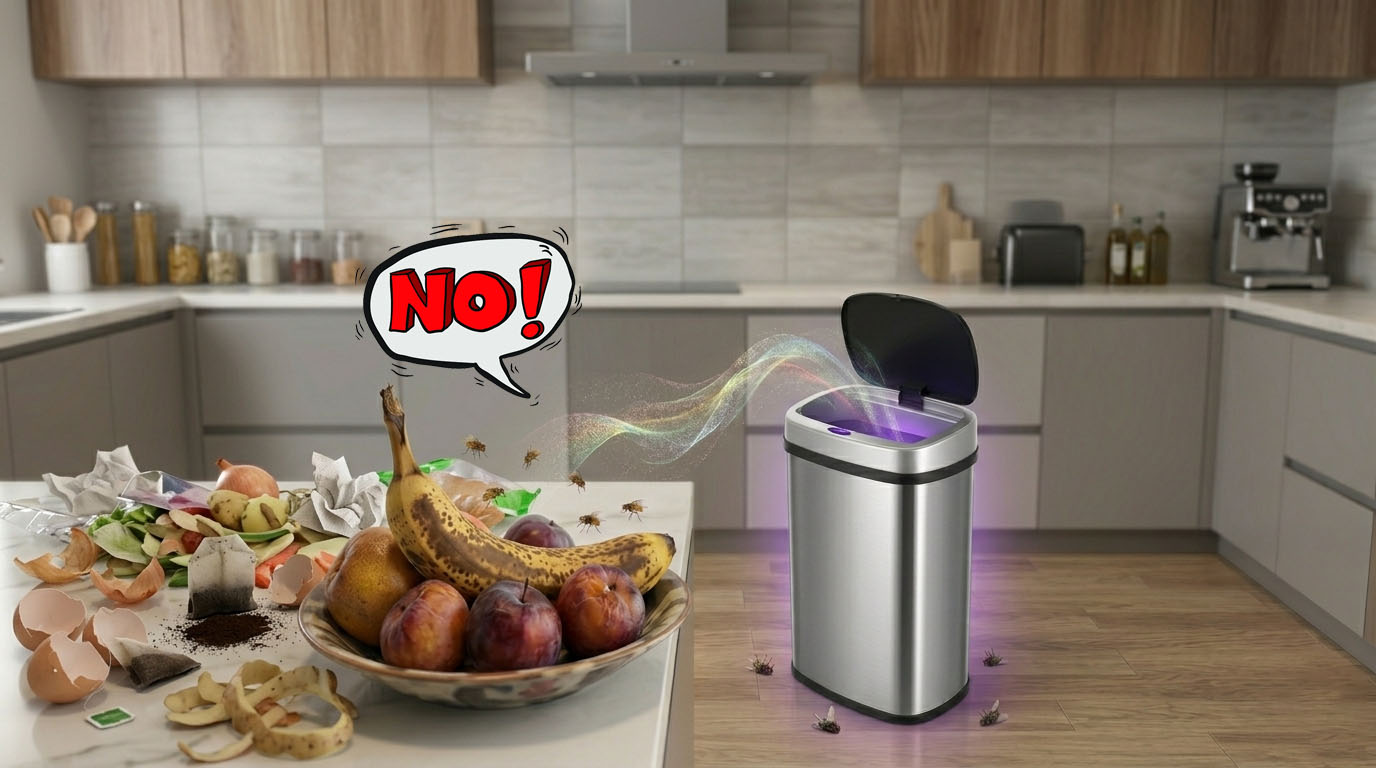
It starts with one. Then three. Within forty-eight hours, your pristine kitchen feels like it’s been colonized by a cloud of tiny, hovering nuisances. Fruit flies (Drosophila melanogaster) are more than just an annoyance; they are a sign that your kitchen’s defense system has a critical breach.
Many homeowners resort to vinegar traps, sticky paper, or chemical sprays. While these might kill a few adults, they are merely treating the symptoms. To solve the problem, you have to eliminate the “command center”—the trash can. Today, we’ll explore how Elylife Smart Home’s revolutionary lid technology is shifting the battleground from pest control to pest prevention.
Fruit flies possess an extraordinary olfactory sense. They can detect the acetic acid produced by rotting fruit and organic waste from hundreds of yards away.
The Trap: Once a fly enters a standard bin, it’s not just eating; it’s breeding. A single female can lay up to 500 eggs in the moist lining of your trash. If your lid isn’t airtight, your bin becomes a high-speed incubator.
The Breach: In a traditional trash can, the seal is often imperfect. Even a microscopic gap acts as a “scent highway,” guiding flies directly to the fermenting organic matter inside.
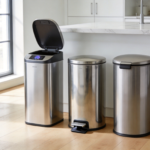
You might think your pedal bin or flip-top bin is secure, but from a design perspective, they have two fatal flaws: Mechanical Lag and Sealing Fatigue.
At Elylife, we approached the fruit fly problem as an engineering challenge. We realized that to say goodbye to flies, the lid technology had to be faster than the insect and tighter than the air.
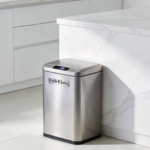
Unlike standard lids that simply rest on top of the bin, Elylife lids utilize a Gasket-Reinforced Perimeter. When the lid closes, the motor applies a final “micro-press” to ensure the lid is flush against the inner rim. This creates a vacuum-like environment that locks odors in, meaning flies can’t find the target in the first place.
Unlike standard lids that simply rest on top of the bin, Elylife lids utilize a Gasket-Reinforced Perimeter. When the lid closes, the motor applies a final “micro-press” to ensure the lid is flush against the inner rim. This creates a vacuum-like environment that locks odors in, meaning flies can’t find the target in the first place.
The lid is the shield, but the inner bucket is the fortress. Fruit flies are attracted to the “bio-slime” that builds up in the corners of cheap plastic bins.
Modern interior design in 2026 is moving away from reactive cleaning toward Proactive Architecture. Homeowners no longer want to hide their trash cans under the sink (where dark, damp conditions actually encourage fly breeding).
By choosing an Elylife Smart Home solution, you are integrating a high-performance appliance into your kitchen that looks like a piece of premium furniture but functions like a laboratory-grade containment unit. It’s the ultimate statement in both style and sanitary discipline.
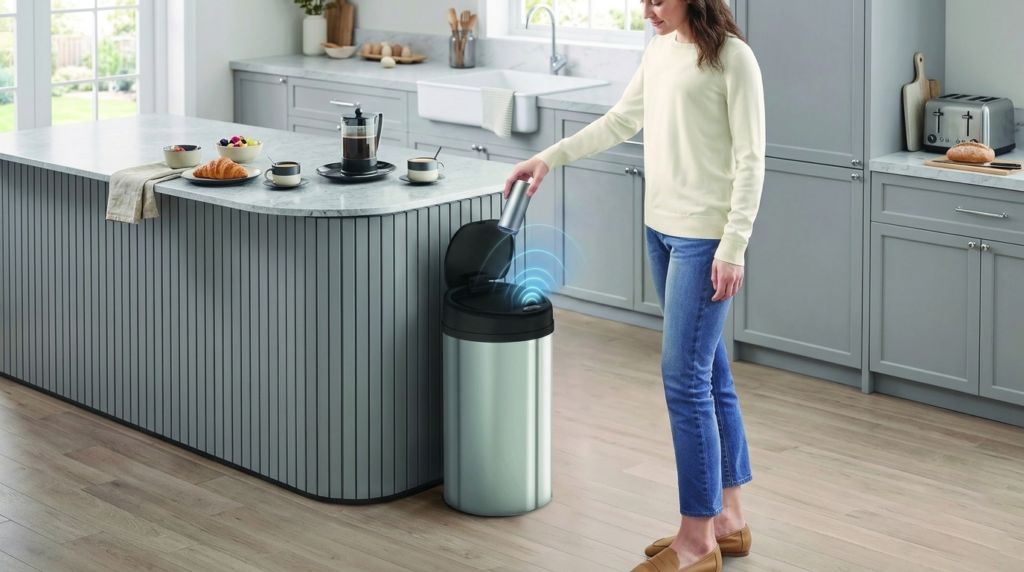
Q1: Can fruit flies actually get inside a closed sensor bin? A: With an Elylife bin, it is virtually impossible. Our precision-engineered seals are designed to be flush. If the lid is closed, the “scent trail” is severed, leaving flies with nothing to track.
Q2: I already have fruit flies. Will switching to an Elylife bin kill them? A: While the bin isn’t a “killer” device, it acts as the ultimate deterrent. By removing their primary food source and breeding ground (the open waste), the existing population will die off or move on, as they can no longer access the organic material they need to survive.
Q3: Does the sensor technology attract flies with light or heat? A: No. Elylife uses passive infrared (PIR) technology that emits no significant heat and no UV light. It is invisible and unattractive to insects.
Q4: How often should I clean the bin to ensure it stays “fly-proof”? A: We recommend a quick wipe-down of the lid’s seal once a week. This ensures no small food particles interfere with the airtight closure. The inner bucket should be rinsed whenever you notice a spill, though our non-stick material makes this rare.
You don’t have to live with the “summer cloud” of flies anymore. The era of the open-air waste bucket is over. By investing in Elylife’s lid technology, you are choosing a kitchen that smells fresher, looks cleaner, and—most importantly—is no longer a playground for pests.
Stop trapping flies. Start blocking them.