Address
304 North Cardinal
St. Dorchester Center, MA 02124
Work Hours
Monday to Friday: 7AM - 7PM
Weekend: 10AM - 5PM
Address
304 North Cardinal
St. Dorchester Center, MA 02124
Work Hours
Monday to Friday: 7AM - 7PM
Weekend: 10AM - 5PM
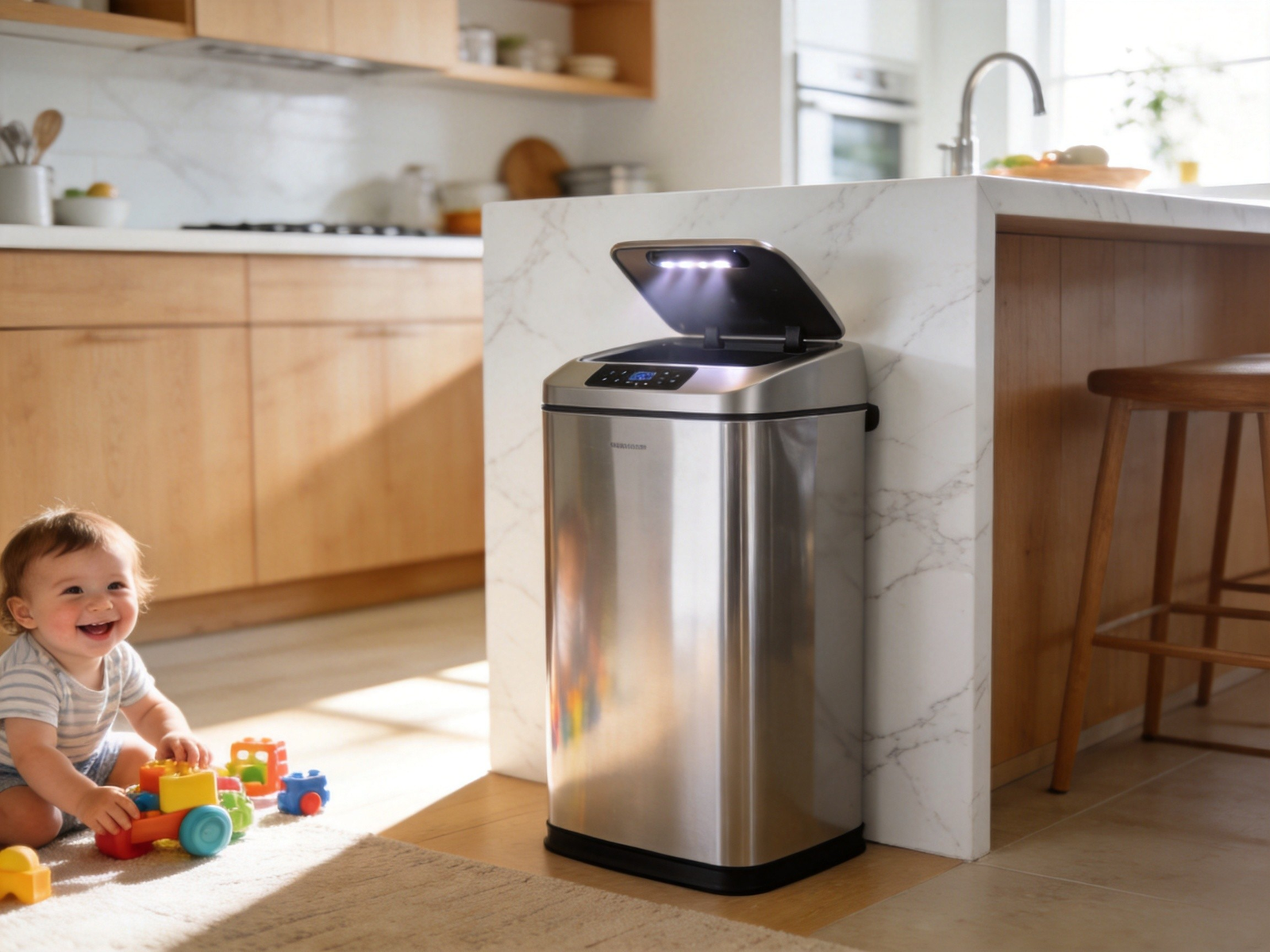
You’ve locked the cabinets. Covered the outlets. Installed latches on the drawers.
But there’s one kitchen hazard that catches thousands of toddlers every year — and it’s sitting in plain sight, right next to the sink.
Your trash can.
According to the U.S. Consumer Product Safety Commission (CPSC), kitchen trash cans are a leading source of childhood injuries in the home, including finger entrapment, exposure to hazardous waste, cuts from sharp debris, and bacterial infections. And the problem isn’t just about what’s inside the bin — it’s about the bin’s design itself.
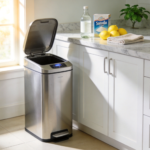
Pedal mechanisms pinch tiny fingers. Heavy lids slam shut on curious hands. Open-top bins invite toddlers to climb and grab.
If you have a crawling baby or a newly walking toddler, your kitchen trash can needs to be on your baby-proofing checklist. Here’s why — and how upgrading to a smart sensor trash can like the Elylife series can solve the problem at its source.
Your kitchen trash routinely contains items that can seriously injure a toddler:
The CPSC reports that children under 3 account for the majority of trash-related emergency room visits, precisely because they explore with their hands and mouths.
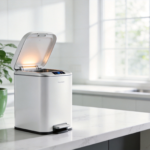
Traditional step-can pedals and flip-top lids create pinch points. The American Academy of Pediatrics notes that finger entrapment injuries are among the most common household injuries in children ages 6-24 months.
How it happens:
Spring-loaded lids close in 0.5-1.0 seconds — fast enough to trap small fingers before a child can pull away.
Between 6 and 18 months, babies go through an intense oral exploration phase. Everything they touch ends up in their mouth. A trash can is one of the most bacteria-dense surfaces in the kitchen. The handle, pedal, and lid rim accumulate biofilms of E. coli, Salmonella, and Staphylococcus from daily use.
For more on how touch-free bins reduce bacterial spread, our guide on How Sensor Trash Cans Reduce Cross-Contamination breaks down the science.
Most baby-proofing advice for trash cans suggests strap locks, relocating the bin, or buying a “childproof” model. Here’s why each falls short.
Strap locks fail on curved or stainless steel surfaces. Toddlers learn to peel them off within days. And parents develop “lock fatigue” — unlocking the strap every single time leads to eventually leaving it off permanently.
Moving the bin inside a cabinet means you must remember to close the cabinet latch every time. Toddlers also master most cabinet latches by 18-24 months. And a hidden bin gets forgotten — leading to overfilled bins and increased bacteria growth.
“Childproof” bins use an unregulated marketing term. Many products simply have a stiffer lid or basic latch — features that slow a toddler but won’t stop a determined one. And stiffer lids mean harder use for elderly family members.
The real solution isn’t adding aftermarket locks to a problematic bin. It’s choosing a design that eliminates the hazard entirely.
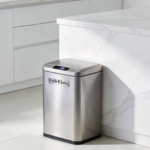
A smart sensor trash can like the Elylife series addresses every major toddler hazard through its core design features — no additional baby-proofing accessories needed.
The infrared motion sensor opens the lid automatically. There is no pedal to step on, no handle to pull, and no lid to flip. This eliminates the three most common mechanisms of finger pinch injuries:
The sensor only activates when someone approaches from the front at standing height. A toddler crawling on the floor typically won’t trigger it.
Elylife sensor bins use a motorized damper system that closes the lid gradually over 1-2 seconds. Compare this to a traditional lid that drops in 0.5 seconds — the soft-close mechanism gives any small hand plenty of time to withdraw.
This is the same principle behind soft-close cabinet doors that have become standard in child-safe kitchen design — built directly into the trash can.
When closed, the Elylife sensor bin forms a sealed enclosure. A toddler cannot open the lid, reach inside to grab sharp objects, or pull the bin over (the smooth exterior offers no grip points for climbing).
For more on how sealed bins protect against biological hazards, our Kitchen Food Safety Guide covers the hygiene science.
Place your sensor bin against a wall where a toddler can’t get behind it, away from climbable furniture, and visible from your cooking area.
Set the sensor to a shorter detection range so the lid only opens when an adult stands directly in front of it — not when a toddler crawls nearby.
A full bin is a tipping hazard and bacteria magnet. Frequent emptying also reduces the temptation for a toddler to investigate overflowing contents.
For broken glass, batteries, or chemical containers, place them in a small tied bag before putting them in the bin — adding secondary containment.
Quality liners prevent leaks and tears that could spill hazardous contents onto the floor. Drawstring liners create sealed bundles when removed.
Even with touchless design, the exterior accumulates kitchen bacteria. A weekly wipe with food-safe disinfectant keeps surfaces clean for curious toddler hands.
Confirm the lid always closes within 2-3 seconds. A malfunctioning sensor that fails to close defeats the entire safety benefit. For troubleshooting, check our Maintenance Guide.
表格
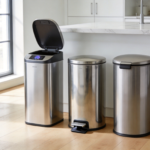
| Safety Factor | Open-Top Bin | Step-Can (Pedal) | Smart Sensor Bin (Elylife) |
|---|---|---|---|
| Pinch injury risk | Low (no moving parts) | High (pedal + hinge) | Near-zero (no mechanical force) |
| Crush injury risk | Low | High (heavy lid drops fast) | Near-zero (soft-close damper) |
| Toddler access to contents | Very High (always open) | Moderate (pedal reachable) | Very Low (requires standing approach) |
| Tip-over risk when pulled | Very High | High (pedal = leverage) | Low (smooth surface, weighted base) |
| Bacterial surface exposure | Very High | High (pedal, rim) | Low (touchless, smooth exterior) |
| Aftermarket locks needed | Yes (often fail) | Yes (unreliable) | No (safety built in) |
| Accessibility for elderly/disabled | Easy | Difficult (foot needed) | Excellent (no foot pressure) |
表格
| Task | Frequency | Time | Safety Benefit |
|---|---|---|---|
| Choose wall-placement for sensor bin | One-time | 5 min | Prevents toddler access from behind |
| Adjust sensor sensitivity | One-time | 2 min | Prevents crawling baby from triggering lid |
| Empty kitchen bin | Every 24-48 hours | 1 min | Reduces bacteria, eliminates overflow |
| Separate sharp/hazardous waste in bags | Daily | 30 sec | Secondary containment layer |
| Wipe bin exterior with disinfectant | Weekly | 2 min | Removes bacterial biofilm |
| Test sensor open/close function | Monthly | 30 sec | Confirms lid always closes safely |
| Deep clean bin interior with vinegar | Monthly | 5 min | Eliminates bacteria buildup |
| Teach “trash is for grown-ups” rule | Ongoing | Daily | Builds lifelong safety habits |
Your kitchen trash can doesn’t have to be a hazard zone. By choosing a smart sensor bin with touchless operation, soft-close design, and a sealed lid, you eliminate the most common injury mechanisms while making daily kitchen life more convenient for every family member — from new parents to aging grandparents. Baby-proof the right way: remove the danger at the source.