Address
304 North Cardinal
St. Dorchester Center, MA 02124
Work Hours
Monday to Friday: 7AM - 7PM
Weekend: 10AM - 5PM
Address
304 North Cardinal
St. Dorchester Center, MA 02124
Work Hours
Monday to Friday: 7AM - 7PM
Weekend: 10AM - 5PM
There are few household problems more stomach-turning than opening your trash can and seeing maggots wriggling inside. If you’re dealing with this right now, don’t panic — you’re not alone, and more importantly, it’s a problem you can solve quickly and permanently. In fact, maggot infestations in trash cans are far more common than most people realize, especially during warmer months.
In this guide, we’ll walk you through exactly why maggots appear in your trash can, how to kill them fast using methods you probably already have at home, and — most importantly — the step-by-step prevention strategies that will make sure they never come back.
Before we jump into solutions, it helps to understand where these pests come from and why your trash can is their favorite breeding ground. Essentially, the entire problem starts with flies.
Flies are powerfully attracted to the smell of decomposing food, particularly meat, fish, dairy, and other protein-rich waste. When a fly detects these odors — even through a slightly open or poorly sealed lid — it lands on the waste and lays eggs. According to pest biology research, fly eggs hatch into maggots within 8 to 20 hours at temperatures between 64°F and 90°F. That means if a fly accesses your bin on a warm afternoon, you could have a full-blown maggot problem by the next morning.
Consequently, maggot complaints spike dramatically during summer. The reason is straightforward: maggots develop fastest at 75°F to 80°F, and decomposition speeds up significantly in heat. Moreover, a trash can sitting in direct sunlight can easily reach internal temperatures where both fly activity and organic breakdown accelerate together. Below 64°F, development slows considerably, which is why maggot problems largely disappear in winter.
To sum up, here are the primary reasons maggots appear in your trash can:
If you’ve already spotted maggots, your first priority is eliminating them. Fortunately, there are several effective methods — ranging from completely chemical-free approaches to heavy-duty disinfection. Below, we’ve ranked them from simplest to most thorough.
This is the go-to solution for a very good reason. Boiling water at 212°F kills maggots on contact — instantly. In fact, you only need water at 140°F (60°C) minimum to achieve near-total larval mortality, according to entomology research.
Here’s what to do:
Best for: Quick elimination of visible maggot clusters. This method is completely chemical-free, making it ideal for households with children and pets.
If you want to kill maggots and neutralize the odors that attracted flies in the first place, a vinegar solution is an excellent choice. Vinegar’s acetic acid breaks down both the larvae and the organic compounds that produce foul smells.
Here’s how:
Additionally, vinegar leaves behind a scent that flies find unpleasant, which provides a short-term repellent effect.
Salt is a highly accessible and surprisingly effective maggot killer. It works by dehydrating the larvae — essentially drawing moisture out of their soft bodies until they die.
Steps:
Note: While effective, salt can be corrosive to metal components over time. Therefore, if your trash can has metal hinges or springs, rinse thoroughly after treatment.
Food-grade diatomaceous earth (DE) is one of the most effective natural options for both killing and preventing maggots. The microscopic particles have razor-sharp edges that cut through the soft bodies of larvae on contact, causing them to dehydrate and die within hours.
How to use it:
Importantly, DE is completely non-toxic to humans and pets, but devastating to soft-bodied insects. The powder remains effective as long as it stays dry, so you may need to reapply after washing the can or if moisture accumulates.
For severe infestations or when you want to ensure every egg and larva is destroyed, a bleach solution provides the most thorough disinfection.
Instructions:
Warning: Always work in a well-ventilated area, wear gloves, and never mix bleach with vinegar or ammonia, as this creates toxic fumes.
Killing existing maggots is only half the battle. Without prevention, the cycle will repeat — sometimes within days. Therefore, building a consistent prevention routine is absolutely essential. Here are the most effective long-term strategies.
This is the single most impactful prevention step. Specifically, you should:
By doing this, you dramatically reduce the odors that attract flies in the first place.
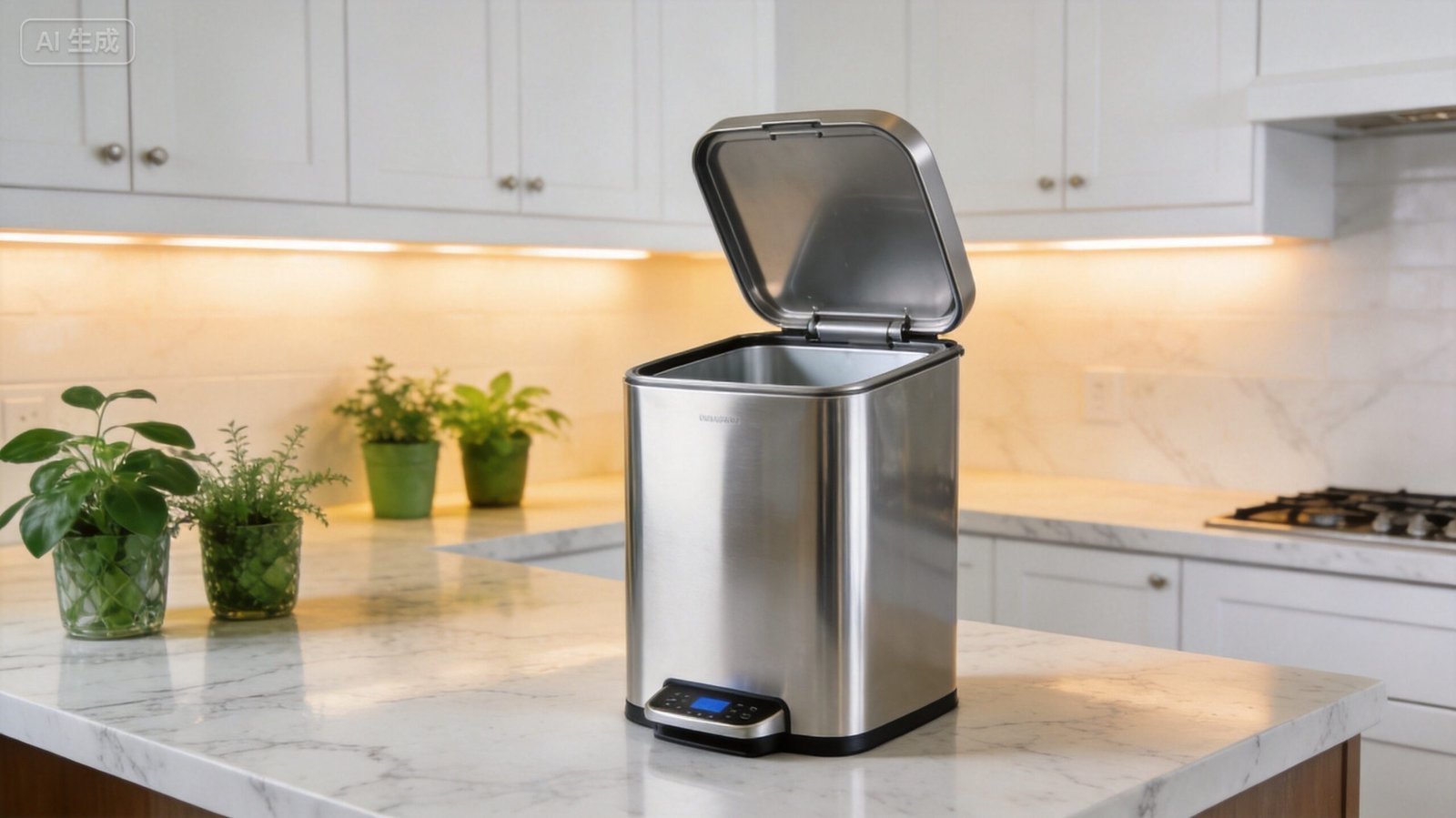
Consequently, one of the smartest investments you can make is upgrading to a trash can with a secure, tight-closing lid. In particular, smart sensor trash cans with auto-closing mechanisms are excellent because they ensure the lid is never accidentally left open. For example, Elylife’s sensor bin series features precision sensor technology that guarantees the lid closes automatically after every use, creating a physical barrier that flies simply cannot bypass.
Moreover, if you’re dealing with persistent fly problems, you might also want to check out our guide on why your trash can attracts fruit flies — and how to stop it for additional targeted strategies.
Moisture is the enemy. Therefore:
For a complete chemical-free cleaning routine, our guide on how to keep your trash can clean without harsh chemicals provides several effective methods.
During warm months, make it a habit to take out the kitchen trash every night rather than letting it build up. Flies need time to find and access your waste — the less time it sits, the lower the risk.
Several natural repellents can make your trash can hostile to flies:
This is a lesser-known trick that works extremely well. Store meat, fish, and dairy scraps in a sealed container in your freezer, and dispose of them right before trash pickup. This completely eliminates the odor window during which flies could detect and access the waste.
After you’ve killed the maggots and cleaned the bin, follow this checklist to make sure the problem is truly over:
If you found this guide helpful, you may also want to read:
Maggots in your trash can are unpleasant, but they’re neither dangerous nor impossible to eliminate. The key is acting quickly to kill the existing larvae, then building a consistent prevention routine that addresses the root causes: exposed food waste, moisture, and fly access. With the right approach — including a quality trash can with a reliable sealing lid — you can keep your bin maggot-free year-round.