Address
304 North Cardinal
St. Dorchester Center, MA 02124
Work Hours
Monday to Friday: 7AM - 7PM
Weekend: 10AM - 5PM
Address
304 North Cardinal
St. Dorchester Center, MA 02124
Work Hours
Monday to Friday: 7AM - 7PM
Weekend: 10AM - 5PM
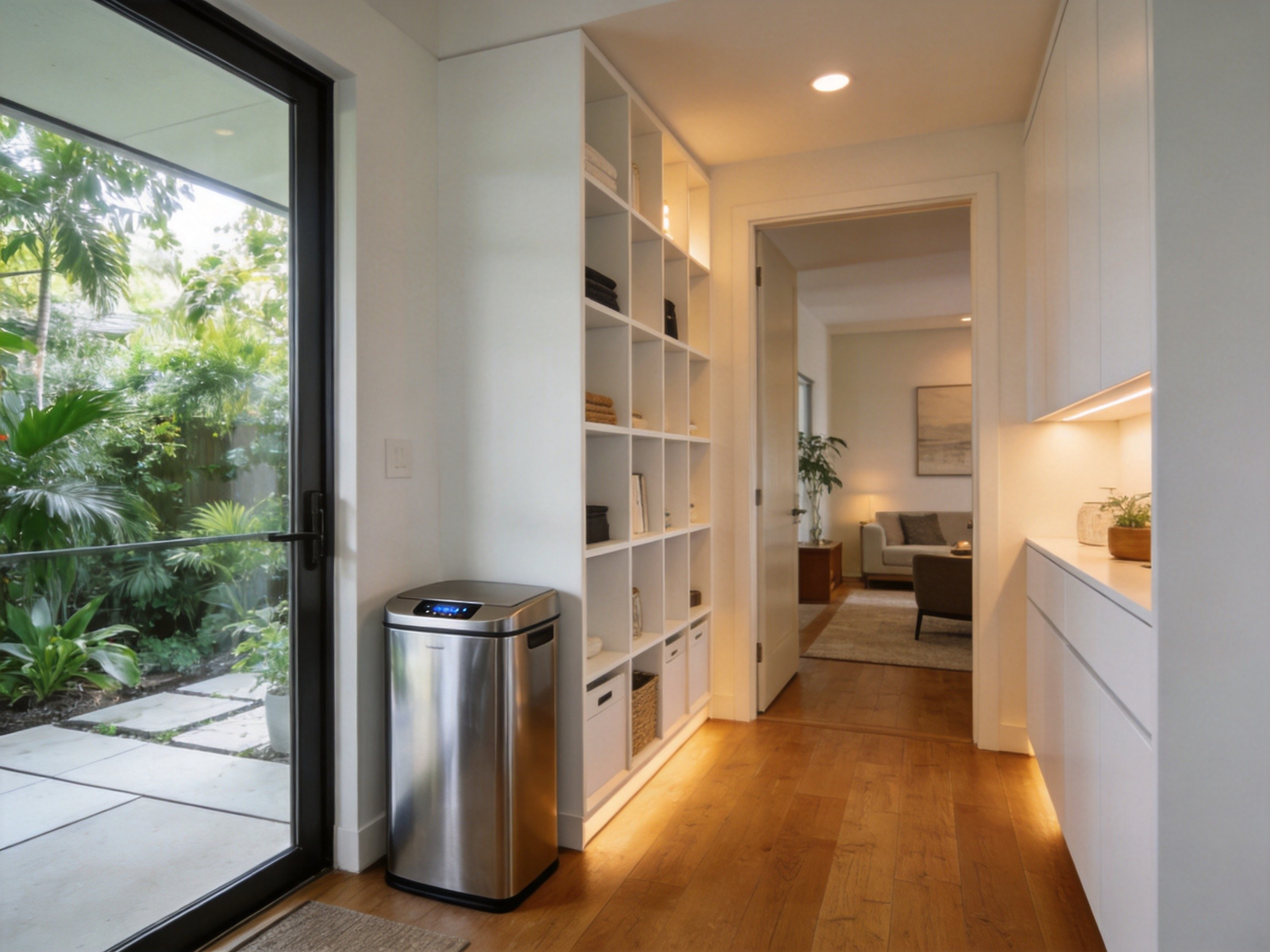
Here’s a question that comes up more often than you’d think: can you just use the same trash can indoors and outdoors? Maybe you want to buy one great bin and use it everywhere. Or perhaps you’ve got an outdoor trash can that seems sturdy enough — so why not bring it inside?
On the surface, it sounds like a reasonable shortcut. After all, a trash can is a trash can, right? Actually, the answer is more nuanced than most people realize. Indoor and outdoor trash cans are designed with very different environments in mind, and using one in place of the other can lead to problems ranging from odor issues to premature wear.
In this guide, we’ll break down the key differences between indoor and outdoor trash cans, when it’s OK to overlap, and what to look for if you want a bin that truly works in both settings.
At first glance, an indoor trash can and an outdoor trash can might look similar. But once you dig into the details, the differences become clear. Essentially, they’re built to handle completely different conditions.
表格
| Feature | Indoor Trash Cans | Outdoor Trash Cans |
|---|---|---|
| Material | Stainless steel, plastic, bamboo finishes | Heavy-duty resin, galvanized metal, UV-treated plastic |
| Size | Typically 8–13 gallons | Usually 20–35+ gallons |
| Weight | Lightweight, easy to move | Heavy-duty, built to stay put |
| Lid type | Sensor, foot pedal, soft-close, swing-top | Hinged lid, open-top, or wind-resistant lid |
| Weather resistance | Not designed for outdoor exposure | UV-resistant, waterproof, temperature-tolerant |
| Odor control | Sealed lids, carbon filters, deodorizers | Less emphasis on sealing (open-air environment) |
| Aesthetics | Sleek, modern, designed to blend with décor | Functional, rugged, less focus on appearance |
| Price range | $20–$150+ | $25–$100+ |
As you can see, the two categories serve very different purposes. Let’s explore each in more detail.
Indoor trash cans are designed for controlled environments — your kitchen, bathroom, bedroom, or office. Consequently, they prioritize convenience, aesthetics, and odor management over raw durability.
1. Touchless or Hands-Free Operation
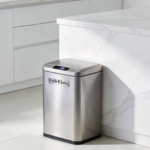
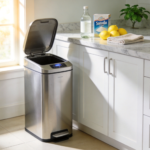
Most modern indoor trash cans feature some form of hands-free opening — whether it’s a motion sensor, foot pedal, or swing-top lid. In fact, this is especially important in the kitchen, where your hands may be dirty or full while cooking. A quality Elylife sensor trash can, for example, opens automatically with infrared motion detection, keeping things hygienic and convenient.
2. Odor Containment
Indoor bins need to manage smells effectively since they’re in close proximity to living and cooking areas. Many come with sealed lids, odor-absorbing filters, or tight-closing mechanisms. Moreover, stainless steel models resist odor absorption in the material itself — unlike some plastics that can retain smells over time.
3. Aesthetic Design
Because indoor trash cans are visible in your living space, manufacturers invest heavily in design. You’ll find brushed stainless steel finishes, matte black coatings, bamboo lids, and slim profiles that fit seamlessly into modern kitchens. In contrast, outdoor bins rarely put design priority above function.
4. Appropriate Size for Indoor Spaces
Indoor trash cans are typically 8–13 gallons for kitchen models and 1.3–4 gallons for bathroom or bedroom models. These sizes are designed to fit in cabinets, beside countertops, or in tight spaces — which is critical for indoor use.
Outdoor trash cans face a completely different set of challenges. They need to handle rain, wind, extreme temperatures, animals, and significantly larger volumes of waste. Therefore, they’re engineered for durability and capacity over finesse.
1. Weather Resistance
Outdoor bins are built from UV-resistant plastics, galvanized steel, or treated resins that won’t crack, fade, or corrode when exposed to sun, rain, and snow. For instance, many outdoor models use UV-stabilized polyethylene that can withstand years of direct sunlight without becoming brittle.
2. Larger Capacity
Outdoor trash cans typically range from 20 to 35 gallons (or more), designed to hold larger volumes between pickup dates. This makes sense — outdoor waste often includes yard debris, packaging, and bulkier items that fill up a bin quickly.
3. Wind and Animal Resistance
A good outdoor trash can has a secure lid that won’t blow open in the wind or be easily accessed by raccoons, squirrels, or stray animals. Many feature latching mechanisms, bungee-ready handles, or weighted bases.
4. Mobility Features
Despite their size, outdoor bins often include wheels or large handles for rolling to the curb on pickup day. In addition, some models feature tie-down points for securing them during storms.
Technically, you can place an indoor trash can on your patio or deck. However, there are some significant caveats to consider.
Bottom line: An indoor trash can can work in a protected outdoor space, but it won’t hold up as a dedicated outdoor bin exposed to the elements.
Similarly, using an outdoor bin inside your home comes with trade-offs.
Consequently, while you can use an outdoor bin indoors, most people find the trade-offs aren’t worth it for primary kitchen or living area use.
If you’re looking for versatility, there are some options that bridge the gap. Specifically, look for these features:
Stainless steel works well in both environments. It’s weather-resistant, doesn’t absorb odors, and looks good indoors. Additionally, it holds up to temperature fluctuations better than plastic.
A tight-sealing lid is essential for indoor use, but it also helps outdoors by keeping animals out and preventing wind-blown litter.
This sweet spot gives you enough room for either setting without being too bulky for indoor use or too small for outdoor tasks.
A smooth interior that works in both settings means you won’t have to worry about residue buildup regardless of where you place it.
In fact, many of the Elylife touchless trash cans are designed with stainless steel bodies and sealed lid mechanisms that perform well in covered outdoor settings like patios, garages, and RVs — making them a solid choice if you want flexibility. For more on choosing the right type, check out our comparison of touchless vs foot-pedal vs swing-top trash cans.
To make it simple, here’s a quick reference to help you decide:
表格
| Situation | Recommended Type |
|---|---|
| Primary kitchen use | Indoor (sensor or pedal) |
| Bathroom | Indoor (small, 1.3–4 gallon) |
| Bedroom or office | Indoor (compact, quiet) |
| Open patio or deck | Outdoor (weather-resistant) |
| Garage or workshop | Outdoor or heavy-duty indoor |
| Covered porch | Either (indoor preferred for aesthetics) |
| RV or camper | Indoor (compact touchless) |
| Pool area | Outdoor (water-resistant) |
| Mudroom or entryway | Indoor with rugged design |
If you’re still unsure, here’s a good rule of thumb: indoor trash cans prioritize hygiene, odor control, and aesthetics, while outdoor trash cans prioritize durability, capacity, and weather resistance. Choose based on the primary environment where your bin will live.
Ultimately, indoor and outdoor trash cans aren’t interchangeable — but there’s some overlap depending on your specific situation. If you need a bin that works in both worlds, prioritize stainless steel construction, sealed lids, and medium capacity.
The key takeaway? Don’t just grab any trash can and assume it’ll work everywhere. Consider the environment, the conditions, and your daily needs. A little thought upfront will save you from a smelly, damaged, or impractical bin down the road.
And if you’re ready to upgrade, a quality smart sensor trash can from Elylife gives you indoor-grade convenience with the durability to handle covered outdoor spaces — giving you the best of both worlds.