Address
304 North Cardinal
St. Dorchester Center, MA 02124
Work Hours
Monday to Friday: 7AM - 7PM
Weekend: 10AM - 5PM
Address
304 North Cardinal
St. Dorchester Center, MA 02124
Work Hours
Monday to Friday: 7AM - 7PM
Weekend: 10AM - 5PM
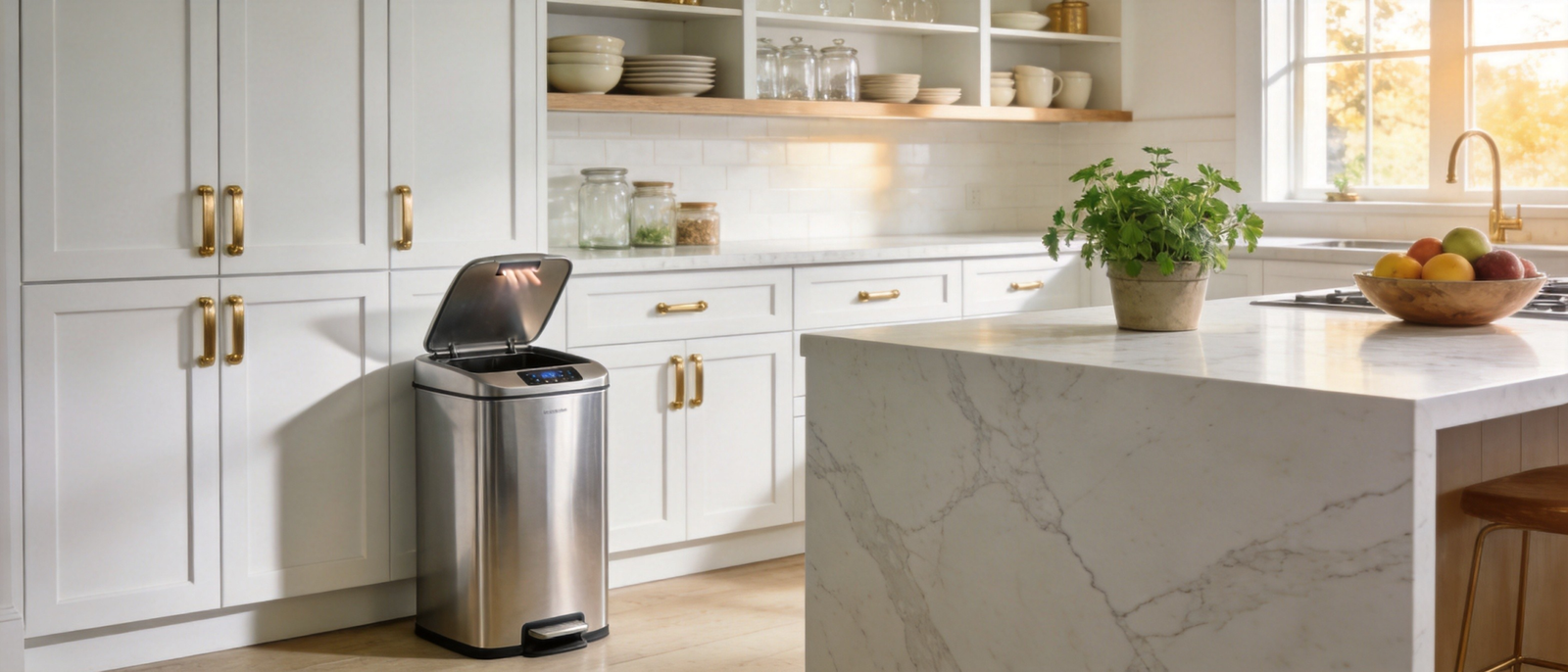
Walk into any home improvement store and you’ll face a wall of trash cans — all different shapes, finishes, and features. But the single most important spec that most shoppers overlook? Capacity. Pick a bin that’s too small, and you’re emptying it every other day. Go too large, and it dominates your space while letting odors build up from half-full bags sitting for weeks.
Getting the size right is especially critical with smart sensor trash cans. These aren’t cheap impulse buys — they’re precision appliances with infrared sensors, motorized lids, and sealed compartments. A properly sized smart bin runs more efficiently, lasts longer, and keeps your home cleaner.
Elylife offers smart sensor bins across three product series (B, K, and M) in capacities from 9 liters all the way to 80 liters. This guide walks through exactly which capacity works best for every room, household size, and lifestyle — so you can make the right choice the first time.
A bin that’s too small creates a chain reaction of frustration. Kitchen bags fill up during a single cooking session. Bathroom bins overflow between emptyings. You end up changing bags more frequently, which wastes liners and defeats the purpose of a hands-free system.
Research from the EPA shows the average American generates about 4.4 pounds of municipal solid waste per day. For a family of four, that’s nearly 18 pounds daily — and that’s before accounting for cooking scraps, packaging, and cleaning waste concentrated in the kitchen.
Oversized bins in low-traffic rooms create their own issues. A half-full 50-liter bin sitting in a guest bathroom for a week collects moisture, bacteria, and smells — especially in warm months. For more on managing odor in smart bins, see our Summer Trash Can Odor Control Guide.
Smart sensor trash cans need clearance above and around them for the lid to open. Placing a 60-liter bin in a cramped powder room means the lid hits the vanity. Sizing down to a 12-liter desktop model solves the problem while still delivering full smart functionality.
For detailed guidance on where to place your bin for optimal sensor performance, check our Sensor Trash Can Placement Guide.
Before matching capacity to rooms, it helps to understand how Elylife organizes its lineup. Each series shares the same core smart technology — infrared sensor, touch control, removable battery tray, splash-resistant design — but targets different needs:
表格
| Feature | B Series | K Series | M Series |
|---|---|---|---|
| Capacity Range | 9L – 18L | 30L – 60L | 30L – 80L |
| Best For | Desktops, bathrooms, small spaces | Mid-size rooms, standard households | Large households, high-traffic areas |
| Body Material | 430 Stainless Steel | Stainless Steel | Stainless Steel (premium finish) |
| Lid Material | ABS Plastic | ABS Plastic | ABS Plastic (reinforced) |
| Power | 4× AA Batteries | 4× AA Batteries | 4× AA Batteries |
| Opening Modes | Infrared Sensor + Touch | Infrared Sensor + Touch | Infrared Sensor + Touch |
| Certifications | Patented design | CE, RoHS | CE, RoHS |
All models feature the same dual-mode opening system: wave your hand within 10–15 cm of the sensor, or tap the lid for manual control. Battery life ranges from 3–7 months depending on usage frequency. For a complete overview of how this technology works, read our Technology Explained Guide.
Bathrooms generate lightweight, low-volume waste: tissue, cotton swabs, packaging, personal care items. A compact bin handles weeks of bathroom trash without dominating the limited floor space.
Top Pick: Elylife B109 (9L) or B112 (12L)
These desktop-sized bins fit beside the toilet, under the vanity, or on a countertop shelf. The B112’s near-circular lid design (25×24.6×38 cm) is purpose-built for tight spaces while maintaining full sensor functionality. Its splash-resistant design handles bathroom humidity without issue.
Bedrooms and offices produce moderate waste — snack wrappers, tissues, notebooks, shipping packaging. You want enough capacity to go a week or more between bag changes without the bin becoming an eyesore.
Top Pick: Elylife B118 (18L) or K130 (30L)
The B118 offers a clean step up from the bathroom models. For larger bedrooms or a combined home office, the K130’s slim 33.5×27.6 cm footprint (48 cm tall) slides neatly beside a desk or into a corner without drawing attention.
The kitchen is where capacity matters most. Cooking generates significant waste — food scraps, packaging, produce trimmings, cans, and containers. A kitchen bin needs to hold a full day’s waste without overflow.
Top Pick: Elylife K130 (30L) for couples, K150 (50L) for families
For households of 1–2 people who cook moderately, the K130 hits the sweet spot. Families of 3+ or anyone who cooks frequently should look at the K150 — its 50-liter volume (33.5×27.6×68 cm) handles heavy kitchen output while the sealed lid keeps odors contained.
For detailed food safety strategies in the kitchen, see our Sealed Smart Trash Can Food Safety Guide.
Garage waste tends to be bulky: cardboard boxes, packing materials, yard waste bags, automotive product containers, and bulk household refuse. You need maximum capacity with minimal emptying frequency.
Top Pick: Elylife M150 (50L), M160 (60L), or M180 (80L)
The M Series premium line handles high-volume disposal. The M180 (80L) is Elylife’s largest capacity bin — ideal for garages, laundry rooms, or homes with multiple pets generating significant waste.
Here’s the lineup organized by capacity, showing one representative model from each series at every size tier:
表格
| Capacity | K Series Model | M Series Model | Best Room |
|---|---|---|---|
| 9L | — | — | Bathroom (B109) |
| 12L | — | — | Bathroom, Desk (B112) |
| 18L | — | — | Bedroom, Office (B118) |
| 30L | K130 ($28.15) | M130 ($33.78) | Kitchen (1-2 people) |
| 40L | K140 ($30.34) | M140 ($35.96) | Kitchen (2-3 people) |
| 50L | K150 ($33.78) | M150 ($39.41) | Kitchen (3+ people), Family room |
| 60L | K160 ($36.59) | M160 ($42.22) | Garage, Utility room |
| 70L | — | M170 ($45.03) | Garage, Large home |
| 80L | — | M180 ($47.85) | Garage, Utility room |
Each capacity tier is available in both K and M Series (where applicable) — the M Series adds a premium finish and reinforced lid. All models share the same sensor technology, battery system, and splash-resistant design. For a deeper dive into the K Series lineup, see our K Series 2026 Buying Guide.
Capacity isn’t just about rooms — it’s about how many people use each bin:
表格
| Household Size | Kitchen Recommendation | Bathroom | Bedroom |
|---|---|---|---|
| 1 person (Studio/1BR) | K130 (30L) | B109 (9L) | B112 (12L) |
| 2 people (1-2BR) | K150 (50L) | B112 (12L) | B118 (18L) |
| 3-4 people (2-3BR) | K150 or M150 (50L) | B112 (12L) | K130 (30L) |
| 5+ people (3+BR) | M160 (60L) or M180 (80L) | B118 (18L) | K140 (40L) |
These aren’t rigid rules — they’re starting points. A couple who cooks elaborate meals nightly may need a larger kitchen bin than a family of four who eats out most days. Adjust based on your actual waste patterns.
One advantage of Elylife’s design philosophy: higher capacity doesn’t always mean a wider bin. Most K and M Series models share the same 33.5×27.6 cm base footprint — they simply scale upward in height. This means a K130 (30L) and a K150 (50L) occupy the same floor space. You gain 20 liters of capacity without needing more room.
This vertical scaling approach matters for kitchen placement. Your bin typically lives beside the fridge, under the counter, or next to the cabinets — spots where floor space is at a premium. Being able to choose 30L, 40L, 50L, or 60L without changing the footprint gives you flexibility to size up without a renovation.
Buying one size for every room. Every room generates different waste at different rates. A uniform approach either over-serves low-traffic areas (creating odor problems) or under-serves high-traffic areas (creating overflow problems). Size each bin to its specific location.
Ignoring vertical clearance. Smart sensor bins need space above for the lid to open. The K150 at 68 cm tall needs more headroom than the K130 at 48 cm — measure your intended spot before choosing.
Forgetting about bag sizing. Larger bins need larger bags. Check bag compatibility before purchasing. Our Complete Trash Bag Guide covers sizing for every Elylife model.
Still unsure? Answer these three questions:
Match your answers to the tables above, and you’ll land on the right model.
Choosing the right smart trash can capacity isn’t complicated once you think room by room and household by household. The B Series handles bathrooms and desktops with compact elegance. The K Series covers the heart of your home — kitchens, living areas, offices — with balanced performance. The M Series steps up for high-volume spaces and larger families.
Every Elylife model shares the same reliable infrared sensor, touch control, splash-resistant build, and long battery life. The only variable is how much waste you need it to handle. Size it right, and your smart bin becomes invisible — working quietly in the background, opening on command, and needing attention only when it’s genuinely full.
Browse the full Elylife collection to find your perfect fit.


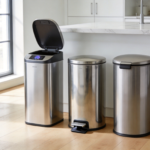
[…] The right size encourages frequent emptying. A bin that’s sized appropriately for your kitchen (30–50L for most households) fills at a rate that encourages regular emptying, preventing the buildup of organic waste. For help choosing the right capacity, see our Smart Trash Can Size Guide. […]
[…] Smart Trash Can Size Guide: Choosing the Right Capacity for Every Room […]
[…] Elylife covers the full spectrum. From a compact 9L bathroom bin (B109) to an 80L utility room workhorse (M180), there’s a sensor trash can for every room and household size. If you want to understand which capacity fits your space, check out our Smart Trash Can Size Guide. […]